


Why advertisers should sit up, prepare — and act now
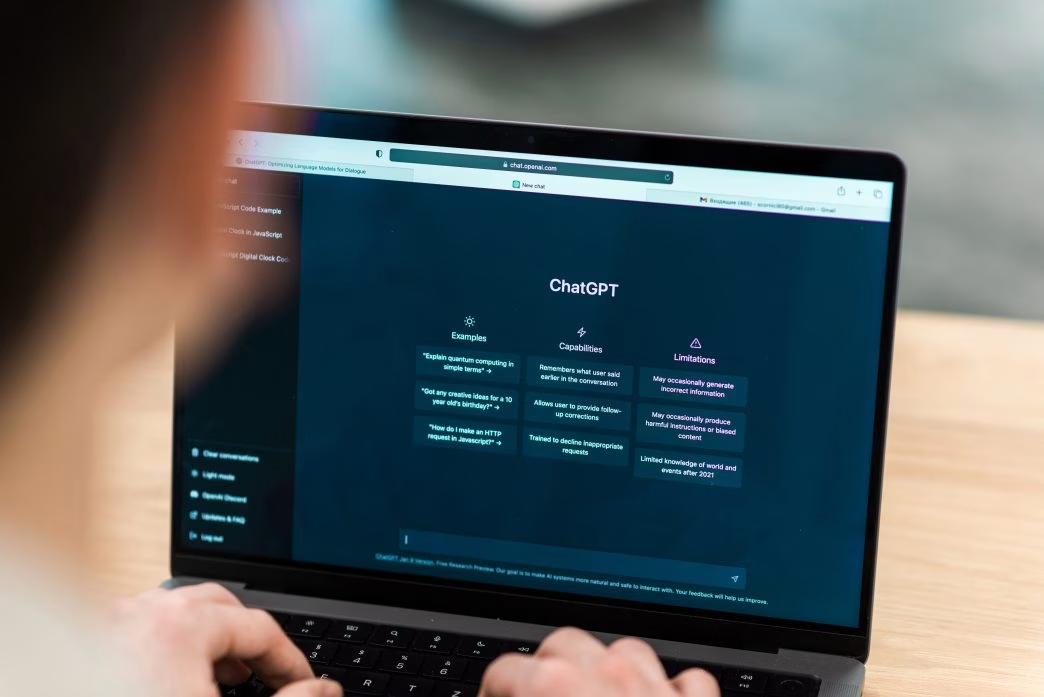
The conversational AI era is here and rapidly evolving. While search and social advertising have dominated for years, the next frontier is being carved out by AI assistants. Among them, ChatGPT ads — with its tens of millions of users — is poised to become a major advertising channel.
Recent reporting from Search Engine Wise confirms that ads are indeed “coming — at some point.” Although a full launch has not been confirmed yet, the implications for designers, UX professionals, advertisers, and content strategists are significant.
In this article, we’ll explore:
- What we know so far about ChatGPT’s ad plans
- What ad formats might look like (and how they differ from Google/Meta)
- What this means for marketers and UX/design teams now
- Actionable steps you can take today to prepare
What we know so far
Revenue motive + user base
- ChatGPT’s parent company, OpenAI, has publicly and internally indicated it may monetise its free user base via ads.
- Internal documents suggest that “free user monetisation” could reach $1 billion by 2026 and potentially up to $25 billion by 2029.
- OpenAI has posted job listings suggesting it is building an in-house advertising infrastructure, such as a “Growth Paid Marketing Platform Engineer” role.
Leadership stance
- CEO Sam Altman has called advertising “uniquely unsettling” for artificial-intelligence assistants, but also said he’s “not totally against it.”
- CFO Sarah Friar previously said there were no active plans to introduce ads, but left the door open for future monetisation.
Timing & status
- Advertising inside ChatGPT is not yet fully live.
- Reports suggest a likely rollout window around 2026 (with testing before then).
What ad formats might look like (and how they’ll differ)
Since there’s no full public specification yet, we need to infer from job postings, competitor moves and expert commentary. The difference between ChatGPT ads and Google/Meta ads will be both subtle and profound.
Format possibilities
Here are likely formats, adapted for a conversational assistant:
- Inline sponsored suggestions: Within the chat response, the assistant might say something like:
- “Based on your interest in hiking boots, you might consider Brand X (sponsored), which offers these features …”
Because ChatGPT already surfaces suggestions and citations, the ad could appear as a “suggestion” or “recommendation” rather than a classic banner. - Pre-response ad unit: Similar to Google’s ad block above organic results, ChatGPT may display a small sponsored card before responding to the user’s prompt.
- Post-response “You may also be interested in…”: After the assistant gives the answer, an ad section may appear with sponsored links or product suggestions.
- Session unlock/premium skip ad: Free users could be shown an ad block in exchange for immediate access to a premium feature session (e.g., deep-dive analysis). Paid users might be ad-free.
- Product/carousel ads in chat: For queries around shopping, suggestions may appear as a carousel of items, some of which are sponsored. For example: “Here are 5 headphones worth considering…” with one or more sponsored placements.
How this differs from Google & Meta
- Conversational context: Unlike traditional search, where keywords drive placement, here, prompts and context are core. The system may use the user’s previous chats, memory and intent to tailor ads.
- Less obvious “slot” boundaries: In a chat stream, ads may feel more integrated rather than separate slots (“Ad” top, then organic). That raises UX/trust challenges.
- Higher engagement intent: ChatGPT users are often seeking answers, in-depth help, or recommendations. That offers high-value ad placement potential — if done thoughtfully.
- User experience risk: Because the assistant aims to be trustworthy, intrusive or irrelevant ads could damage credibility — something OpenAI leadership has publicly acknowledged as a concern.
What this means for marketers, UX & content teams now
If you’re designing user experiences, building content strategies, or managing advertising budgets, here’s how this potential shift should affect your roadmap.
For marketers & advertisers
- Early mover advantage: When ad inventory becomes available in ChatGPT, competition is likely to be lower than in established channels. Getting “in early” could mean better cost, visibility and data.
- Rethink targeting: Instead of relying on keywords alone, you’ll need to optimise for prompts, conversational patterns, memory, and context. The ad tech stack for ChatGPT may emphasise intent + context more than classic demographics.
- Budget diversification: Don’t rely solely on Google/Meta forever. Start allocating a small portion of your testing budget toward “emerging AI-assistant advertising” so you’re ready when the channel opens.
- Brand Critique & Trust: Since trust is a key asset in AI assistants, your ad creative must align with transparency (clear sponsorship labels), relevance, and provide genuine value; otherwise, you risk eroding your brand.
For UX & design teams
- Ad integration without disruption: The design must ensure that ad placements within chat don’t disrupt the flow or distract from its utility. Consider micro-unit design: sponsored suggestions, subtle card UI, clear “ad” disclosure.
- User mental model shift: Users are used to “organic + paid” in search results. Chat interfaces are not structured in that manner; clear UX cues will be necessary so users can distinguish between unbiased assistant responses and sponsored content.
- Responsive & safe-area aware: Given your front-end/design focus, when ads appear in ChatGPT sessions (mobile, desktop, tablet), you’ll need to ensure safe-area padding, accessibility (WCAG AA), contrast tokens, alt-text, etc. And since conversational UIs may embed rich media (such as carousels, images, and links), load time and performance need to be optimised.
- Measuring success in a new context: Traditional metrics (CTR, CPC, conversion) may need to be extended: e.g., chat session length, downstream action from a chat suggestion, and brand lift within an assistant context. Design dashboards accordingly.
For content creators & SEO professionals
- Answer engine optimisation (AEO) matters: Even before ads appear, being referenced or cited by ChatGPT will be vital. Reports indicate that AI referral traffic is increasing (~1% of site traffic in certain industries) and that being cited in AI-generated answers enhances visibility.
- Schema, structured data & authority: Your content should be “assistant-ready” — i.e., well-structured, easy for an AI to parse, with FAQs, tables, optimised snippets, product schema, organisation/author schema.
- Think conversationally: Since users will ask ChatGPT in natural language (“What hiking boots are good for a beginner under ₹10,000 in India?”) rather than in keyword style (“hiking boots India cheap”), content needs to mirror that conversational intent.
- Prepare for “brand mention” without paid placement: Even without paying for ads, brands may be referenced in ChatGPT answers organically. Position your brand so that when users ask relevant questions, your brand appears in those helpful responses.
Key challenges & considerations
No shift of this magnitude comes without risk. Here are key friction points to watch:
- User trust & credibility: If ads are poorly labelled or blended too seamlessly, users may feel misled. That could degrade the assistant’s utility and deter users. OpenAI has acknowledged trust concerns.
- Privacy & context-based targeting: If ads are based on memory or user chat history, privacy concerns will escalate — and regulators may step in. According to reports, OpenAI is exploring memory-based advertising.
- Ad fatigue & UX disruption: Chat experiences are valued for their conversational flow. Interrupting that with heavy ads could backfire and degrade retention.
- Measurement & attribution complexity: If the user interacts via voice, chat, or multi-step prompts, attributing a conversion to a particular “ad” will be more complex than with a click-to-landing-page approach.
- Global rollout, localisation & language: ChatGPT has global users; ad formats need to be adaptable, culturally sensitive, and localised. Design tokens, UX flows, and responsive patterns must be considered.
- Competition & saturation risk: If/when ads open, many brands will jump in. Early advantage matters, but so does a strategic approach to avoid getting lost or paying inflated CPMs.
Actionable roadmap — What you can do today
Here’s a practical 90-day + 12-month preparation plan aligned to your design/UX/content orientation.
Short-term (0-3 months)
- Audit your website content: Ensure you have strong brand/authority pages, FAQ schemas, structured data, and conversational answer-style content.
- Map your AI referral traffic: Use GA4 / other analytics to see how much traffic you’re getting from “assistant” or “AI” sources (if tracked) and what the engagement is like.
- Update your design token library: Ensure your UI assets (safe-area insets, responsive breakpoints, WCAG AA colours, alt-texts) are ready for chat interface ad placements.
- Brainstorm possible “assistant ad” creative formats: Work with designers/devs to create mock-ups of how a sponsored suggestion might look inside ChatGPT chat UI (mobile & desktop). Consider A/B flows: card UI vs inline text vs interstitial.
- Training & stakeholder alignment: Run a workshop with marketing/UX/content teams about the shift to “AI assistant advertising” and how the roles will evolve (prompt-based ads, conversational copy, session metrics).
Mid-term (3-12 months)
- Set aside a test budget: Design a pilot ad experiment for when ChatGPT’s ad inventory becomes available. Define KPIs beyond clicks — e.g., “chat session initiated”, “brand mention after session”, “micro-conversion”.
- Build attribution modelling: Work with the analytics/data team to incorporate chat-assistant channels into your conversion model.
- Expand content for conversational prompts: Create a library of conversational-style content that maps to user questions (“What’s the best smartphone under $500 for photography?” etc.). Include micro-answers suitable for AI assistants.
- UX Integration Guidelines: Document how “sponsored content inside chat” should appear in your product/service flows (e.g., avoid disrupting free users, clearly label sponsored suggestions, and maintain transparency).
- Monitor competitive move: Keep an eye on early adopters, case studies, industry reports (e.g., SearchEngineWise, SEO blogs) to see how early advertising inside ChatGPT is performing.
Long-term (12 + months)
- Diversify ad platforms: Once chat-assistant ad inventory is live, optimise budget across multiple platforms (search, social, assistant ads) based on ROAS.
- UX/Design Evolution: Based on user behaviour and metrics, iterate the ad placement UI within chat flows to optimise for minimal friction and maximum value.
- Content authority solidification: By then, being cited by assistants (even without direct paid ad placement) will be a major competitive moat. Continue building backlinks, authority content, and structured data, and ensure your brand is referenced in AI responses.
- Measure lifetime value of assistant-channel users: Compare LTV, retention, conversion rate for users coming via assistant ad vs search ad vs organic search.
- Stay agile with creative formats: The ad format may evolve (voice assistant, multimodal chat with images/videos, immersive experiences). Be ready to experiment.
Final Thoughts
Ads inside ChatGPT ads are inevitable, though the exact timeline and format remain fluid. For designers, UX-oriented teams, content strategists and marketers, this is a major inflexion point: the shift from keyword-based search advertising to prompt-based assistant advertising.
Getting ahead means:
- Thinking conversationally, not just keyword-wise.
- Ensuring your UX and design assets can smoothly integrate “sponsored suggestions” without disrupting trust or the user experience.
- Building your content and brand authority so you’re positioned, whether you pay or not.
- Testing and preparing now so you’re ready for roll-out.
When ChatGPT opens its ad inventory, early adopters — especially brands that align with high-intent queries and conversational contexts — will have an outsized advantage.
Your design tokens, responsive layouts, front-end frameworks (including mobile, desktop, and Safari iOS fixes), and content structure will all matter more than ever in this evolving landscape.

Author