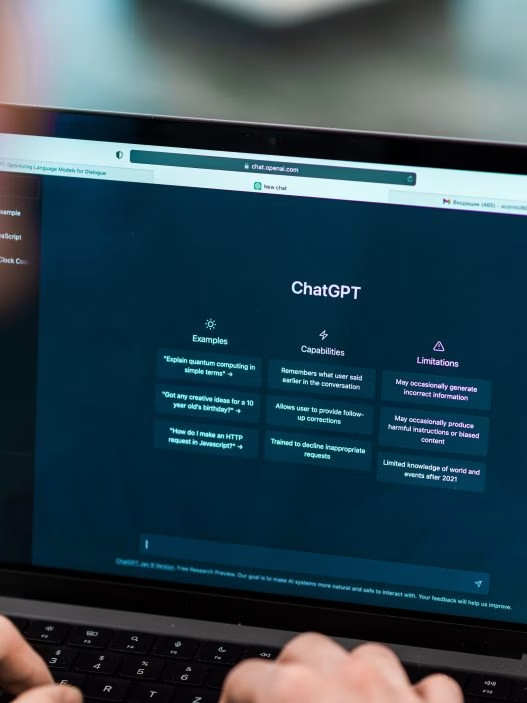








ChatGPT is poised to launch a native shopping feature through a formal partnership with Shopify, enabling in-chat purchases and potentially positioning the AI platform as a combined shopping and review destination.
This development raises significant questions about its potential impact on Google’s long-standing search dominance and advertising revenue. While Google currently handles approximately 373 times more searches than ChatGPT and maintains over 93% market share in search, the integration of e-commerce functionality directly into conversational AI represents a novel approach that could reshape how consumers discover and purchase products online.
The Evolving ChatGPT-Shopify Integration
OpenAI has reportedly added code that indicates ChatGPT will host Shopify as a formal partnership rather than just providing affiliate links. According to revelations by Testing Shopify Catalog, the code includes fields for price, shipping, buy now options, and checkout buttons.
This integration would enable users to complete purchases directly within their ChatGPT conversations instead of being redirected to external websites, creating a seamless shopping experience that eliminates traditional friction points in the e-commerce journey.
How the Integration Works
The partnership between ChatGPT and Shopify represents a significant shift in how consumers might interact with e-commerce platforms. Instead of the traditional multi-step process of searching for products, visiting various websites, comparing options, and then checking out, users could accomplish the entire purchase journey through a single conversational interface.
When implemented, this system will likely function by allowing ChatGPT to surface product recommendations based on a user’s query, display pricing and shipping information, showcase reviews, and then facilitate the actual purchase-all within the conversation flow. The feature appears positioned to sit alongside weather and market data in ChatGPT’s answer panel, suggesting it will be prominently displayed to users.
“If implemented, users will be able to complete purchases in their ChatGPT conversations instead of moving to external sites,” reports The Economic Times, highlighting how this removes the traditional barriers between product discovery and purchase.
This streamlined approach could fundamentally change how consumers shop online by collapsing the typical conversion funnel into a single conversational experience.
The integration creates a win-win scenario for both companies. For OpenAI, it adds valuable functionality that keeps users engaged with ChatGPT for longer periods and potentially opens new revenue streams. For Shopify, it provides access to ChatGPT’s massive user base without requiring merchants to handle complex technical integrations.
Current Status and Timeline
While neither OpenAI nor Shopify has officially confirmed the partnership, code analysis suggests the feature is close to rollout. The integration appears to be well-developed, with specific functions for displaying product information, processing purchases, and linking to Shopify’s checkout system already embedded in ChatGPT’s codebase.
This development comes amid a broader industry trend toward AI-facilitated shopping experiences. Microsoft recently launched the Copilot Merchant Program, which enables in-chat storefronts for eligible sellers, while Perplexity AI introduced a one-click ‘Buy with Pro’ feature in late 2024.
Google’s Search and Advertising Empire
Google’s search business remains the dominant force in digital discovery, with recent data showing it processed approximately 5 trillion searches in 2024-roughly 14 billion searches per day. This massive scale translates directly into Google’s primary revenue stream: advertising.
The Financial Picture
In the first quarter of 2025, Google reported advertising revenue of $66.8 billion, an 8.5% increase from the previous year. Within this total, Google’s “Search & Other” segment generated $50.7 billion, reflecting a 9.8% year-over-year growth. These figures underscore the continued strength of Google’s core business model despite growing competition from AI platforms.
Google’s parent company, Alphabet, reported total revenue of $90.23 billion for Q1 2025, with net profit jumping 46% year-over-year to $34.54 billion. The company’s cloud services, which increasingly incorporate AI functionality, brought in $12.26 billion, showing 28% growth compared to the previous year.
Google’s E-commerce Positioning
Product searches represent a crucial segment of Google’s business. When consumers search for products, Google displays shopping advertisements, product listing ads, and organic results that frequently lead to e-commerce sites. These commercial queries are particularly valuable from an advertising perspective, as they often indicate high purchase intent.
Google has continually evolved its shopping features, including Google Shopping, which allows users to browse and compare products directly within search results. The company has also developed tools that enable merchants to list their products both organically and through paid placements.
ChatGPT’s Growth and Market Position
While ChatGPT has experienced remarkable growth since its launch, its position relative to Google in search remains modest. Understanding ChatGPT’s scale helps put the potential threat to Google in context.
User Base and Growth Trajectory
According to company announcements, ChatGPT reached 400 million weekly active users worldwide as of February 2025, up from 300 million in December 2024. This rapid growth continues the trend that began with ChatGPT’s launch in November 2022, when it acquired one million users in just five days.
In the United States specifically, ChatGPT has an estimated 67.7 million monthly active users. The adoption rate varies significantly by age group, with 43% of adults ages 18-29 having used ChatGPT, compared to only 6% of adults over 65.
ChatGPT accounts for approximately 62.5% of the market share among AI tools, making it the dominant player in the conversational AI space. OpenAI is reportedly targeting 1 billion users by the end of 2025, reflecting ambitious growth plans for the platform.
Current Search Market Share
Despite ChatGPT’s impressive user numbers, its share of search-like queries remains relatively small compared to Google. According to analysis by SparkToro’s Rand Fishkin, even if all of ChatGPT’s 1 billion messages per day were search-related (which they are not), its total share of the search market would be less than 1%.
In reality, only about 46% of ChatGPT queries involve search functionality, and just 30% of prompts qualify as “traditional” search-like behavior. This translates to an estimated 37.5 million search-like prompts per day on ChatGPT, giving it approximately 0.25% market share compared to Google’s 93.57%.
Potential Impact on Google’s Business
While the current numbers suggest minimal immediate threat to Google’s search dominance, the ChatGPT-Shopify integration introduces a new competitive dimension that could have longer-term implications.
Disrupting the Product Discovery Journey
The integration of Shopify’s checkout functionality into ChatGPT creates a potential alternative path for product discovery and purchase. Instead of starting their shopping journey with a Google search, consumers could increasingly turn to ChatGPT to ask about products, get recommendations, and now, make purchases directly.
This shift could be particularly significant for certain types of shopping queries where consumers are seeking recommendations or comparative analysis. For example, a user asking “What are the best running shoes for flat feet?” might receive not only information but also purchasable product options directly within ChatGPT’s interface.
As AI technology continues to improve, ChatGPT could become increasingly effective at understanding user preferences and providing personalized product recommendations. This capability, combined with frictionless checkout, could make it a compelling alternative to traditional search for certain types of commercial queries.
Impact on Advertising Revenue
Google’s business model relies heavily on advertising revenue generated when users click on ads displayed alongside search results. If a significant portion of product discovery queries were to shift to ChatGPT, it could potentially impact Google’s advertising revenue over time.
However, several factors mitigate this risk in the near term:
- Scale difference: Google processes approximately 373 times more searches than ChatGPT handles search-like queries.
- Diverse ad inventory: Google’s advertising extends well beyond search to include YouTube, display advertising, and its broader network.
- Established merchant relationships: Google has deep relationships with merchants and advertisers built over decades.
- User habits: Search behavior is deeply ingrained in consumer habits, with “Googling” synonymous with online search.
Consumer Behavior and Adoption
The success of ChatGPT’s shopping integration will ultimately depend on consumer adoption. While conversational interfaces offer convenience, they also represent a significant shift in how people shop online.
Some consumers may prefer the visual browsing experience offered by traditional e-commerce sites and search engines, which allow for easy comparison of multiple products simultaneously. Others might find the conversational approach more natural and efficient, particularly for purchases where personalized recommendations are valuable.
The integration could be especially appealing to younger demographics who already show higher adoption rates for ChatGPT and who tend to be more open to new shopping experiences. If these users develop a habit of shopping through ChatGPT, it could gradually reshape e-commerce patterns over time.
Google’s Response to AI Competition
Google has not been passive in the face of growing AI competition. The company has been aggressively developing and deploying its own AI capabilities to maintain its position at the center of online discovery.
AI-Enhanced Search
Google has integrated AI into its search functionality through features like AI Overviews, which now reaches 1.5 billion users per month. These AI-generated summaries appear at the top of search results for certain queries, providing concise answers without requiring users to click through to websites.
The company has been refining its Search Generative Experience (SGE), which represents a significant evolution of traditional search by incorporating more conversational and AI-driven elements. SGE aims to blend the best aspects of traditional search with the natural language capabilities of AI chatbots.
Leveraging Google’s Advantages
Google maintains several significant advantages in its competition with AI chatbots:
- Data infrastructure: Google crawls approximately 1.12 billion websites and 50 billion web pages daily, giving it unmatched indexing capabilities.
- Real-time updates: Google can almost instantly update news events and surface them in search results, outperforming ChatGPT’s more limited database.
- Integration ecosystem: Google owns multiple products with over a billion monthly active users each, including Chrome, Search, YouTube, Android, Maps, and Google Play, creating a powerful network effect.
- Advertising expertise: Google has decades of experience in monetizing search through advertising, with sophisticated systems for matching ads to user intent.
Financial Strength and Investment
Google’s financial resources allow it to invest heavily in AI development. Over the past five years, the company has poured $150 billion into research and development to support its AI infrastructure. This substantial investment demonstrates Google’s commitment to maintaining its technological edge in the face of competition.
Expert Perspectives on the Competitive Landscape
Industry experts and analysts offer varying perspectives on whether ChatGPT’s expansion into e-commerce represents a serious threat to Google’s business.
The Disruptive Potential
Supply chain expert Brittain Ladd has identified the OpenAI-Shopify collaboration as a landmark move that could elevate ChatGPT to the forefront of online shopping. Ladd emphasizes that embedding a native checkout flow within ChatGPT could make transactions more seamless, potentially accelerating delivery services and creating new advertising revenue streams for OpenAI.
The integration represents what some observers describe as “the collapse of the traditional conversion funnel”. By compressing the typical multi-step shopping journey into a single conversation, ChatGPT could fundamentally alter how consumers discover and purchase products-a change that could ultimately affect Google’s position in the e-commerce discovery process.
Measured Assessments
Other analysts take a more measured view of the competitive dynamics. The significant disparity in scale between Google Search and ChatGPT suggests that any impact on Google’s business would likely be gradual rather than immediate.
Research indicates that despite being a popular talking point, there is currently “no evidence that vast numbers of searchers are abandoning Google for ChatGPT and other AI search engines and chatbot experiences”. In fact, Google’s search volume has continued to grow year over year.
Some experts note that while ChatGPT could evolve into an “all-in-one app” through its integration with Shopify, this shift might also represent a diversion from OpenAI’s original mission of advancing Artificial General Intelligence (AGI) toward a more commercially driven model. This transition raises questions about the strategic focus and long-term direction of OpenAI.
The Future of Search and E-commerce
The ChatGPT-Shopify integration is part of a broader evolution in how consumers find and purchase products online. This evolution has several important dimensions:
Conversational Commerce
The integration of chat interfaces with e-commerce functionality represents the rise of “conversational commerce”-a model where consumers discover, evaluate, and purchase products through natural language interactions rather than traditional browsing and searching.
This approach offers several potential advantages, including:
- More natural expression of needs and preferences
- Personalized recommendations based on conversational context
- Reduced friction between discovery and purchase
- Potential for deeper engagement through interactive assistance
As AI systems become more sophisticated in understanding user intent and preferences, conversational commerce could become increasingly prevalent, potentially reshaping how consumers interact with brands and products online.
Multi-Modal Search
The future of search is likely to be multi-modal, with consumers using different interfaces and approaches depending on their specific needs and contexts. Traditional keyword search, voice search, visual search, and conversational AI may all coexist as complementary rather than strictly competitive approaches.
Google itself appears to be embracing this multi-modal future, developing capabilities across different search modalities while also enhancing its core search product with AI features. This diversified approach reflects the understanding that different types of queries may be better suited to different interaction models.
The Evolving Role of AI in Discovery
AI is increasingly mediating the discovery process, whether through Google’s AI Overviews, ChatGPT’s recommendations, or other AI-powered platforms. This shift raises important questions about how products and information are surfaced to consumers and the factors that influence these AI-driven recommendations.
As AI becomes more central to discovery, the strategies that businesses use to ensure visibility will need to evolve. This could include optimizing for conversational queries, providing structured data that AI systems can easily interpret, and developing direct integrations with AI platforms.
Implications for Businesses and Marketers
The emergence of ChatGPT as a potential e-commerce channel has significant implications for businesses and marketers looking to reach consumers online.
Multi-Platform Strategies
Businesses may need to develop multi-platform strategies that encompass both traditional search engines and AI chatbots. This could include:
- Optimizing content for both keyword-based search and conversational queries
- Ensuring products are available through multiple channels, including Shopify integrations that could appear in ChatGPT
- Developing distinctive brand voices and product descriptions that stand out in AI-mediated discovery
- Building direct relationships with consumers that transcend specific platforms
The most successful strategies will likely be those that recognize the complementary nature of different discovery channels rather than viewing them as strictly competitive alternatives.
Evolving SEO Practices
Search engine optimization practices will need to continue evolving to account for AI-mediated discovery. Google’s E-E-A-T guidelines (Experience, Expertise, Authoritativeness, and Trustworthiness) provide a framework for creating high-quality content that both traditional search engines and AI systems are likely to value.
As AI systems become more sophisticated in evaluating content quality, businesses that consistently demonstrate these qualities may have advantages across different discovery platforms. This includes:
- Creating content that demonstrates genuine expertise
- Building authoritative brand positioning within specific niches
- Ensuring factual accuracy and trustworthiness
- Incorporating authentic experience into content creation
These principles apply whether content is being surfaced through Google’s search results or as part of ChatGPT’s responses to user queries.
New Opportunities in AI Commerce
The integration of ChatGPT and Shopify also creates new opportunities for businesses to reach consumers in innovative ways. Some potential strategies include:
- Developing products that address specific needs frequently mentioned in conversational contexts
- Creating distinctive product descriptions optimized for AI-mediated discovery
- Building brand recognition that transcends specific platforms
- Leveraging the conversational nature of ChatGPT to provide more personalized product recommendations
For Shopify merchants specifically, this integration could provide access to ChatGPT’s large user base without requiring complex technical implementation3. As noted in one report, “For Shopify’s millions of merchants, this could be a huge boon. Right now, most small sellers have to hustle for traffic, investing in SEO, ads, or pleading with mysterious social media algorithms to go viral”.
Final Thoughts
The reported ChatGPT-Shopify integration represents an innovative approach to e-commerce that could potentially influence how consumers discover and purchase products online. By enabling in-chat purchases, ChatGPT is positioning itself as more than just an information source, expanding into the realm of transaction facilitation.
However, current data suggests that the immediate impact on Google’s search business is likely to be limited. Google processes approximately 373 times more searches than ChatGPT handles search-like queries, and its market share remains above 93%. The company’s advertising revenue continues to grow, with Q1 2025 showing an 8.5% year-over-year increase in ad revenue to $66.8 billion.
Google has also been proactively enhancing its own AI capabilities, with features like AI Overviews now reaching 1.5 billion users monthly. The company’s substantial financial resources and deep expertise in search and advertising provide significant competitive advantages as it adapts to the evolving landscape.
Rather than viewing the situation as a zero-sum competition, a more nuanced perspective recognizes that different discovery models may serve different types of queries and user needs. The future is likely to involve multiple complementary approaches to online discovery, with businesses needing to develop strategies that span traditional search, conversational AI, and various specialized platforms.
For consumers, the integration of ChatGPT and Shopify represents an additional option for discovering and purchasing products-one that may offer advantages in terms of convenience and personalization for certain types of shopping journeys. How significantly this will reshape e-commerce patterns depends on factors including user adoption, technological advancement, and the ongoing evolution of competing platforms.
What’s clear is that AI is becoming increasingly central to how consumers discover and interact with products online. Whether through Google’s AI-enhanced search or ChatGPT’s conversational interface, the fundamental landscape of e-commerce discovery is evolving in ways that will require continued adaptation from both platforms and the businesses that rely on them for visibility.
The Road Ahead: Monitoring Impact and Evolution
As the ChatGPT-Shopify integration moves from code discovery to public launch, several key metrics will help determine its actual impact on Google’s search business:
- ChatGPT’s growth in search-like queries related to product discovery
- Changes in consumer behavior, particularly for younger demographics
- Adoption rates among Shopify merchants
- Google’s search volume for commercial queries
- Advertiser spending patterns across platforms
The true test will come not just from the technology itself, but from how consumers choose to incorporate it into their shopping habits. Will conversational AI fundamentally change how people discover and purchase products, or will it serve as a complementary channel alongside traditional search?
The answer will likely unfold gradually as these technologies continue to evolve and as consumers experiment with new ways of shopping online.

Author